Draw It Before You Buy It
In a small apartment every ten centimetres counts. Measure each room and draw it on squared paper or in a simple app, marking doors and their swing, windows, AC units and sockets. Then decide what each space must do: will the living room also be the dining room? Will the bedroom hold a desk? Knowing the functions first stops you buying pieces that have nowhere to go.
- Measure the front door, lift and stairs too; a sofa that will not fit through the door is a common problem.
- Mark walkways and leave 75–90 cm for them.
- Rank your needs and start with the pieces you cannot do without.
Furniture of the Right Scale
An oversized piece swallows the room, while many small pieces make it look scattered. A few well-judged, medium-sized pieces work best.
- A sofa with slim arms instead of wide rolled ones; the difference can be 30 cm in length for the same seating width.
- Furniture raised on legs, so the floor shows underneath and the room reads as larger.
- Low backs on sofas and chairs so they do not block the view across the room.
- A round or oval pedestal dining table instead of a large rectangle.
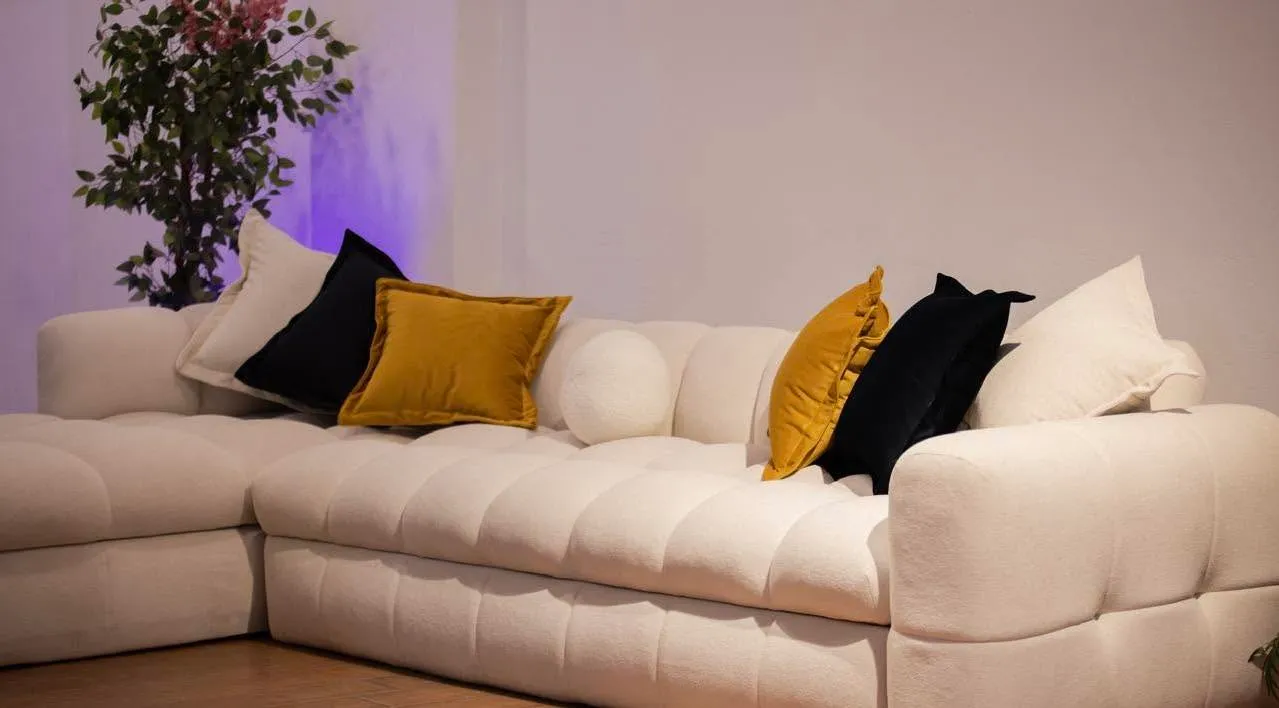
- Avoid bulky corner sofas unless they fit a specific corner exactly.
If the living area is open to the kitchen or dining space, define each zone without walls: a rug to gather the seating, a pendant over the table, and the back of the sofa turned towards the dining area to form a natural edge. The space stays open and the light flows through, yet everyone knows where to sit and where to eat.
Multifunctional Pieces
- Storage bed: a gas-lift base or drawers underneath can replace an extra wardrobe.
- Extending dining table: four seats every day, more for gatherings.
- Sofa bed for a room that occasionally hosts overnight guests.
- Storage ottoman or bench that serves as a seat, a small table and a box at once.
- Nesting tables that pull out when needed and tuck back.
- A fold-down wall desk, or a console deep enough to work at.
Choose these with sturdy mechanisms; anything opened and closed every day must be well made, so test it before you commit.
Mirrors and Daylight
A large mirror beside or opposite the window reflects daylight and doubles the room's apparent depth. Mirrored wardrobe doors in the bedroom give a full-length mirror without another piece. Hang curtains close to the ceiling and wider than the window, so the window looks bigger and lets in more light when open. In the evening, spread light across several points instead of one ceiling fitting; dark corners shrink a room.
Colour
Light, warm walls such as off-white, beige and pale grey make a space feel larger. That does not mean everything white: pick one calm base colour and two accent colours for details. It helps when large pieces are close to the wall colour so they blend in, rather than a big dark sofa against a white wall reading as a heavy block. Dark colours are not banned; put them in cushions, accessories or a single wall. A continuous floor throughout the apartment, without changing material between rooms, also makes the space feel connected.
Vertical Storage
When floor space runs out, use the height:
- Floor-to-ceiling wardrobes instead of standard heights that collect dust and boxes on top.
- Shelves above doors, the desk and the bed.
- A wall-hung TV unit with drawers, leaving the floor visible underneath.
- The space under the bed, and under the stairs if there is one.
- Hooks and racks on the back of doors for bags and towels.
Avoiding Clutter
A small apartment fills up fast, and clutter shrinks it more than anything.
- One in, one out: every new item that comes in, an old one leaves.
- Keep most storage closed and use open shelves for display only.
- Leave at least one surface clear in every room.
- Fewer, larger accessories rather than many small ones.
- Give every item a fixed home; whatever has no place ends up on the table.
Made to the Size of Your Apartment
Ready-made pieces rarely fit a small apartment's walls exactly, and made-to-measure uses every centimetre between window and door. At Arti Design we make furniture to the size of your space; size, wood, fabric and colour are approved with samples before production, and you can book a free survey visit for measurements.